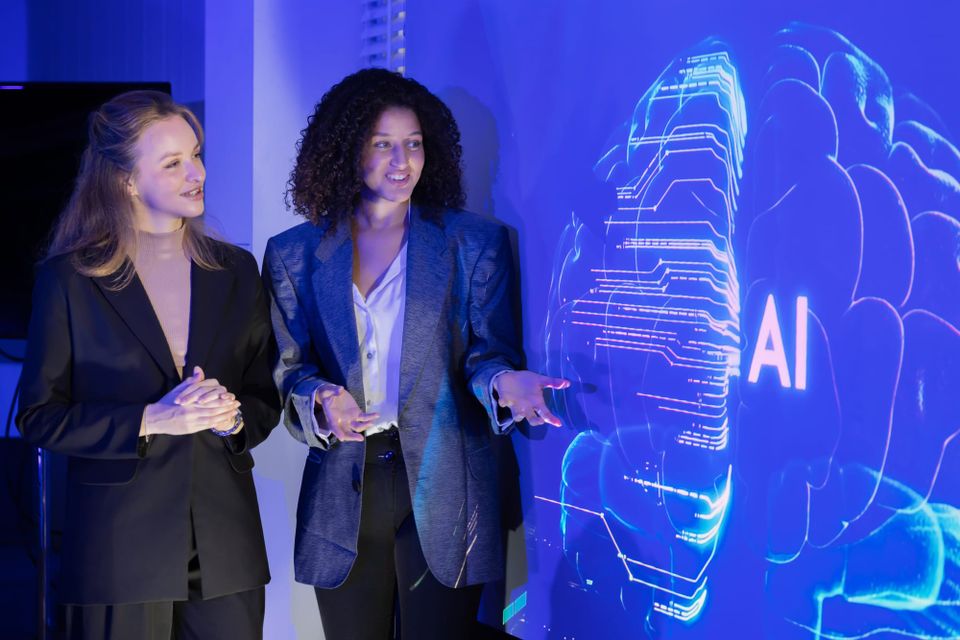
The AI Coworker Is Already Here - And Most Companies Still Aren’t Ready
AI is no longer just a tool on the side. It is starting to act more like a coworker — and that shift could change how companies work faster than many leaders expect.

For a while, AI felt like something extra.
A useful tool.
A smart shortcut.
A productivity boost sitting quietly on the edge of real work.
That phase is ending.
AI is starting to move closer to the center of how work actually gets done. Stanford’s 2025 AI Index says 78% of organizations reported using AI in 2024, up from 55% the year before — a jump that suggests AI is no longer just an experiment for early adopters.
That is why the real AI story is changing.
It is no longer only about better chatbots, faster search, or impressive demos.
It is about whether businesses are ready for AI to behave less like a tool — and more like a coworker.
The shift is bigger than most people think
This is where the conversation gets more serious.
Microsoft’s 2025 Work Trend Index argues that a new model of work is emerging, built around hybrid teams of humans and agents. In the same report, 82% of leaders said this is a pivotal year to rethink key aspects of strategy and operations, and 81% said they expect agents to be moderately or extensively integrated into their AI strategy in the next 12 to 18 months.
That matters because it changes the question.
The old question was:
Can AI help people work faster?
The new question is:
What happens when AI starts taking on real parts of the workflow?
That is a much bigger shift.
This is moving from assistant to teammate
The most useful way to understand the moment we are in is this:
AI is moving from assistant to teammate.
Microsoft describes one phase of this shift as agents joining teams as “digital colleagues,” taking on specific tasks under human direction. Anthropic’s January 2026 Economic Index points in a similar direction: it found AI use spread across more than 3,000 unique work tasks on Claude.ai, with augmentation making up 52% of conversations there, while more automated usage remained dominant in API traffic, where companies tend to build AI directly into workflows.
That is important because it tells you two things at once.
First, AI is already being used across a surprisingly wide range of real work.
Second, businesses are not using it in just one way.
Some are using it to support human thinking.
Others are pushing it toward automation.
And that gap is where the future of work starts to get interesting.
This is not just a productivity story
A lot of AI coverage still frames everything through one lens: productivity.
That matters, but it is too narrow.
The bigger business story is about structure.
If AI can draft, summarize, research, analyze, write, plan, and handle parts of execution, then companies do not just gain speed. They gain the ability to rethink who does what, how teams are built, and where human attention is most valuable. Microsoft says organizations are moving toward a model that is AI-operated but human-led, which is a much deeper change than simply giving employees a better tool.
That is why the AI coworker idea matters so much.
It is not really about replacing a person with a robot headline.
It is about redistributing work.
Why many companies still are not ready
This is where the story becomes uncomfortable.
Adoption is rising fast, but readiness is not just about turning on a tool.
It is about redesigning processes, setting rules, deciding where human judgment still matters most, training teams to use AI well, and knowing when automation helps versus when it quietly creates more risk.
Microsoft’s 2025 Work Trend Index says 24% of leaders report their companies have already deployed AI organization-wide, while only 12% remain in pilot mode. That sounds like progress. But it also suggests companies may be rolling forward quickly into a phase that requires much more operational discipline than simple experimentation ever did.
In other words, many companies may be adopting AI faster than they are redesigning work around it.
That is a dangerous mismatch.
Workers should pay attention too
This is not only a leadership story.
It is also a worker story.
Anthropic’s data suggests AI use remains concentrated in some high-frequency tasks, especially coding-related work, but it is broadening into education, writing, design, and other forms of knowledge work too. That means the pressure is no longer limited to one narrow technical group.
For workers, that creates a strange new reality.
The people who benefit most may not simply be the most technical.
They may be the ones who learn how to:
- direct AI well,
- check outputs carefully,
- combine speed with judgment,
- and use AI to expand what they can handle without losing quality.
That is why the smartest way to read the AI shift is not:
Will AI take my job tomorrow?
It is:
How will AI change what strong work looks like in my field?
The winners will probably be the companies that redesign work first
Not every company using AI will win.
Some will bolt it onto messy processes and create even more confusion.
Some will chase hype and get little real value.
Some will save time in the short term but weaken quality, trust, or decision-making.
The real winners will probably be the companies that do something harder:
They will redesign work.
They will decide what should stay human.
What can become AI-supported.
What can become AI-run.
And where judgment, accountability, and creativity still matter most.
That is harder than buying software.
But it is where the real advantage will come from.
Final thought
The AI story is no longer just about smarter tools.
It is about a new kind of working relationship.
The companies that understand this early will not just move faster.
They will build differently.
Hire differently.
Train differently.
And compete differently.
Because the next big shift in AI is not just that machines are getting better.
It is that more businesses are starting to treat them like part of the team.
If you want clear, useful insights on AI, business, and the shifts shaping how we work, subscribe to Morning News Catcher.